

Did you know that George Lucas originally wanted Tom Selleck to play Indiana Jones? However, contractual obligations to Selleck’s moustache and, of course, his role as Magnum P.I. got in the way and landed Harrison Ford as the iconic Professor Jones instead. This story has absolutely no bearing on today’s Risk Report except for the provision of some semi-funny puns.
Back in October of 2025, both the Bank for International Settlements (BIS) and the International Monetary Fund (IMF) raised concerns about Private Letter Ratings (PLRs).
A PLR is a confidential credit rating assigned to (often private) securities by a Nationally Recognized Statistical Rating Organization, or NRSRO. These ratings are shared only with the issuer or specific investors and are not publicly disclosed. PLRs are increasingly used to determine how much capital insurance companies should hold to cover losses on their investments. Securities with a rating of 1 or 2 are considered investment-grade and require less capital than those with a rating between 3 and 6, which are considered various shades of junk.
BIS and IMF are more than implying that, given the less transparent nature of both the assets and the ratings, then maybe this is an area where objectivity and truthfulness could be ever so slightly sliding sideways.
And these worries are not entirely conjured from thin air.
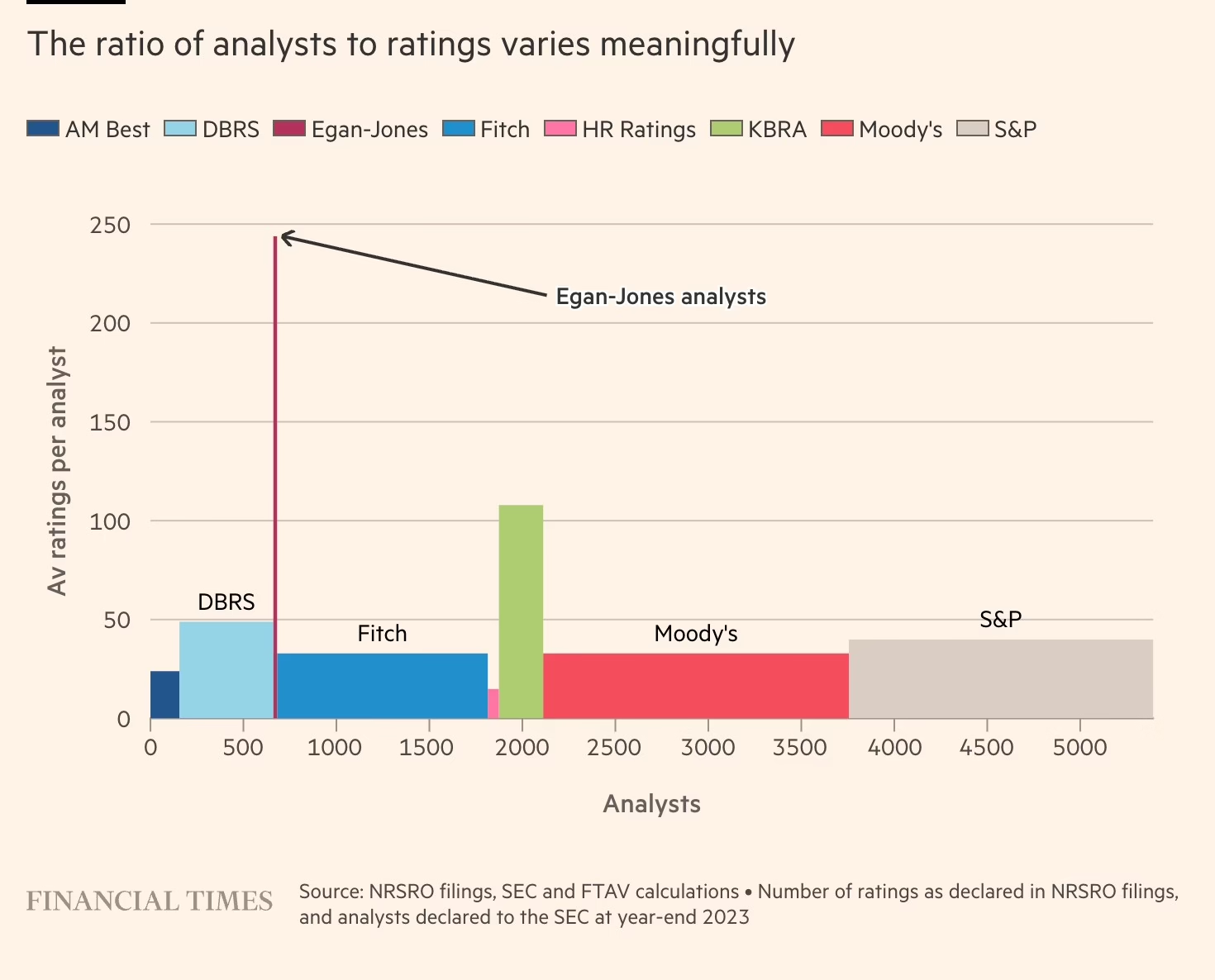
There are not that many recognized rating agencies. Basically, there are only the three big ones—Moody’s, S&P, and Fitch—and then a handful of smaller ones. The smaller ones have really had a growth spurt in the number of PLRs issued since 2019. One of them, Egan-Jones (not Indiana), especially stands out for their productivity, as illustrated by this chart from the Financial Times’ Alphaville section:
Furthermore, a 2025 report (now retracted*) from the National Association of Insurance Commissioners (NAIC) stated that the PLRs were, on average, significantly better than those issued by “regular” credit rating providers—close to three notches.
That could be why the SEC is said to be looking into whether Egan-Jones senior executives have been exerting improper commercial influence on its rating procedures. At the same time, the SEC has been considering Egan-Jones’ application to rate government debt and asset-backed securities again, which it was banned from in 2013.
This week, in a filing, the SEC said it has further “questions about the adequacy of EJR’s financial and managerial resources to consistently produce credit ratings with integrity” and will reserve its conclusion until after a hearing in August.
While this is just a few data drops in the cup of PLRs, both IMF and BIS feel the need to single them out:
Misclassification of below-investment-grade instruments into the investment-grade bucket may result in default losses significantly exceeding those expected during an economic shock. -IMF, Global Financial Stability Report, October 2025
These [private letter] ratings are concentrated among smaller rating agencies, which may face commercial incentives to assign more favourable ratings. This opacity can lead to inflated assessments of creditworthiness and, correspondingly, undercapitalised exposures. -BIS, BIS Papers No 161, The transformation of the life insurance industry: systemic risks and policy challenges, October 2025
And weren’t uncovered exposures also in the plot of Raiders of the Lost Ark? Coincidence? I think not!
*The reason why the report was retracted for further editing was that it caused a shouting match between some of the PLR agencies involved.
Regitze Ladekarl, FRM, is FRG’s Director of Company Intelligence. She has 25-plus years of experience where finance meets technology.
This article is part of the FRG Risk Report, published weekly on the FRG blog. To read other entries of the Risk Report, visit frgrisk.com/category/risk-report/.