AI poses all kinds of risks; macroeconomic, cyber, and credit are just a few examples.
This week has been especially rife with concerns and warnings from around the globe.
Since we are already talking about The Odyssey, a Greek myth goes that the god Apollo granted Cassandra, of Trojan notoriety, the gift of true prophecy as a token of his love.
Cassandra said, “Oh, nice!” and then promptly ghosted him.
That got Apollo a tad miffed, and he twisted the gift so that while Cassandra would always be able to accurately predict what was to come, nobody would believe her. Sad.
Much, much later, both Florence + The Machine (2022) and Taylor Swift (2024) wrote songs about her, and I just thought that was worth mentioning.
These days, you can hardly open your phone for some solid doomscrolling without being hit with posts about all the ways AI is a risk, which is probably both true and believable.
Last week the Monetary Authority of Singapore warned that AI is both an economic and a cyber risk.
Economic because so many investments are riding on it being wildly productive and profitable, but the pudding to prove that might be considerably slower in the making than hoped. In the meantime, we could be contending with a (negative) reset of expectations and global stagflation.
Cyber because financial institutions are part of the massive technological ecosystem that connects the globe. That system is getting more and more vulnerable to malicious intent by the minute, not in the least from agentic AI, which can apparently now stage cyber-attacks on an industrial scale in a misguided attempt to win at testing (see reports on why/how OpenAI hacked Hugging Face).
The European Central Bank (ECB) and the Bank of England (BoE) are also concerned about the cyber threat posed by AI. Earlier this month, the ECB wrote to 110 European banks and gave them until October to come up with a comprehensive action plan for combating attacks by the newest frontier models. BoE has chosen more of a "let’s-figure-it-out-together" approach, but is nonetheless urging UK banks to protect themselves.
Also, the good economists at the Bank for International Settlements (BIS) pointed out that the AI boom is giving mixed signals. Since everything AI is moving so quickly, our data collection methods are coming up short and late, which makes it difficult to know what is going on and when to do something about it.
If the current—especially US—growth is because everybody wants to get on the AI train before it really takes off, it could get bubbly and end with a burst. That requires one kind of monetary policy. If we are starting to see some conversion of AI investment into productivity, that might sustain longer-term growth, and the monetary policy can be more hands-off. Even worse, if we think it is one and act accordingly, and it turns out to be the other, that can end not so well.
At the same time, the Bureau of Economic Analysis is reworking how inflation is measured, which is said to lower the metric closer to the Federal Reserve’s target and could scramble the signals even more.
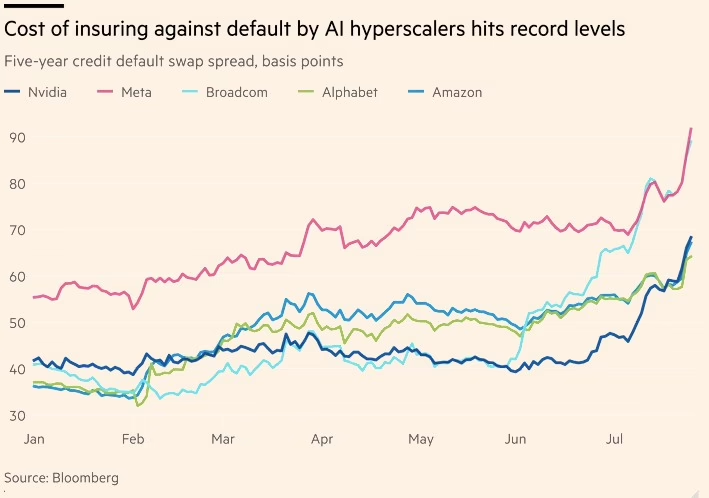
And by the looks of it, AI investors are also worrying more about the bubble thing and are buying insurance against losses in the form of credit default swaps (CDS). This year and especially this past month have seen the spread—which is like the insurance premium—on AI hyperscalers increase significantly.
But even if we believe the Cassandras and accept that AI can (and will) leave disruption, damage, and loss in its massive wake, the question is: what can we do about it other than be aware of the risks and keep on getting it to work? It is not like we can ask Pandora to put AI back in the box (different Greek myth, I know!)