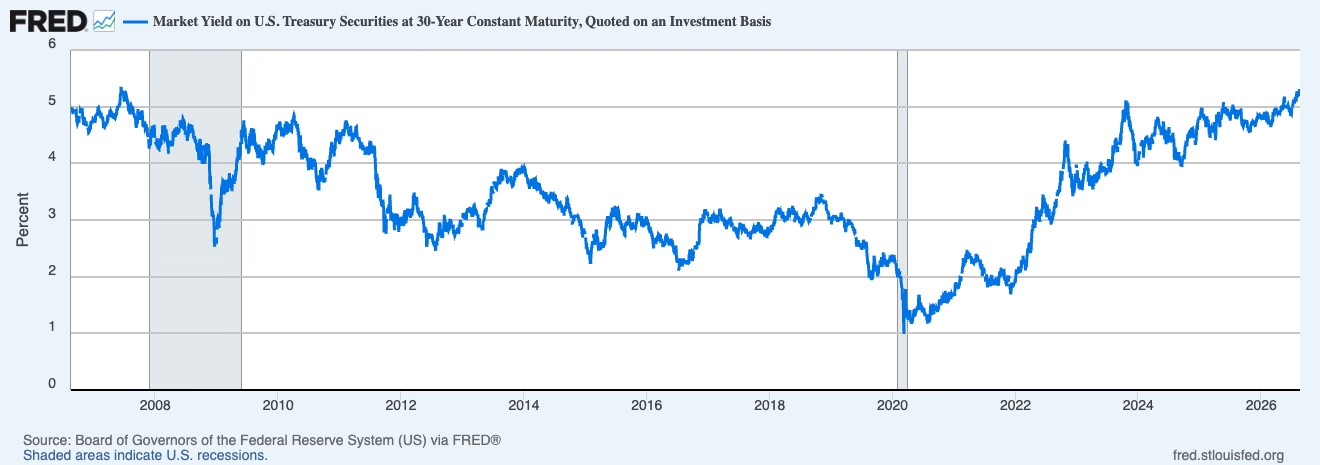
Interest rates are, well, interesting because they are both a barometer and a valve for the economy. Recently, the needle has been pointing to a storm. Read more about it below.
In financial markets, interest rates are both the wind that moves the economy forward and the sails we use to weather the storm. And let’s just say that lately there have been some high seas and attempts at wave management.
The markets have three major concerns that blow in the direction of higher interest rates:
First, inflation is back on. It is driven by much higher fuel prices, and if that is not inflationary enough, almost every production flow in modern economies requires fuel injection, and thus those prices go up as well. The financial markets have taken matters into their own keyboards by selling off Treasury bonds, which are not worth as much in real terms when inflation is high. And when bonds are sold off, the supply increases, the bond prices decrease, and the interest rates go up.
Second, now there is AI, and Treasury bonds are not as attractive anymore. The AI juggernaut is to a large extent financed by debt issuance, AKA corporate bonds. Since every investor and their aunt wants a piece of that new shiny cake, good ole safe Treasury bonds pale in comparison. In practical terms, investors ask for fewer Treasuries at the counter and sell off some of what they already have to fund their AI habit, and both push interest rates higher.
Third, the safety of US Treasury bonds has been called into question by the Debt & Deficit Duo. This week the national debt turned the corner of 40 trillion dollars, and the payments on it are this year estimated to contribute to a budget deficit of 2 trillion dollars. That is a lot, and while the financial markets are not by any stretch jumping the US ship, they are considering how many of their nest eggs go into the Treasury cargo hold in case the debt waves get really choppy. As we have already established, Treasury bonds sold off cause interest rates to go up.
Since it falls to the Treasury Department to finance and service the debt, it is so not interested in higher interest rates, which make the job harder. As it cannot lower rates by itself, it has tried to handle the supply of Treasury bonds instead.
So, when the interest rate winds picked up this week with a bond sell-off and the imminent release of the debt figures, the Treasury secretary, Scott Bessent, timed it with an announcement that the department will (at least) double its scheduled bond buyback program in early September. The Treasury regularly buys back older and less-traded securities to ensure the market is liquid and running smoothly, but very rarely at this magnitude, which seems less like housekeeping and more like market intervention.
However, there are several good reasons for not intervening, namely that it is costly and the effect is often short-lived. When the US Treasury stepped in to help strengthen the Japanese yen in late July, it took only a few weeks for half of the JPY gain to evaporate. Coincidentally, the US Treasury helped Japan by selling euros and buying yen, so the Bank of Japan (BoJ) would not have to sell off its vast holdings of US Treasury bonds to prop up its currency.
And as of reporting time, this week’s storm still seems to be building, with financial markets having largely shrugged off the surprise buyback announcement and long-term bond yields hovering around a nearly two-decade high point.